
Why You're Not Getting Therapy Client Enquiries (And What Actually Works)

Abby Rawlinson, psychotherapist, author and private practice coach
I think private practice marketing has changed more in the past two years than it did in the previous ten.
That might sound a little dramatic, but I genuinely think it's true. AI has arrived. Google has changed. Social media is more crowded than ever. And clients are doing far more research before they decide who to contact.
And yet most therapists are still being told much the same things: niche down and post more.
If you're doing those things and the enquiries still aren't landing in your inbox, it isn't because you’re bad at marketing. It's usually because the advice itself has stopped matching the way clients actually find and choose a therapist.
As a psychotherapist and private practice coach, when I look back over the coaching conversations I've had this year, the same three things keep coming up. Here's what I see getting in the way — and what to do instead.
Why am I not getting therapy client enquiries?
If enquiries aren't coming in, it's usually not a lack of effort. It comes down to three things: positioning that isn't clear, website copy that sounds like every other therapist, and marketing treated as scattered tasks instead of done in the right order.
I want to say this gently, because most therapists I meet are already working hard. You're on the directories. You've tried Instagram. You've got a website. The problem is almost never that you're doing too little. It's that the pieces aren't working together, and the right person isn't quite recognising themselves when they land on your page.
Let's take the three in turn.
Do therapists really need to niche to get clients?
No. Niching is one good way to stand out, but it isn't the only one. What actually brings enquiries is clear positioning - the right person landing on your website and immediately thinking, "I want to work with this therapist." You can do this as a Niche Therapist, a Memorable Generalist, or a Spotlight Therapist.
I actually like niches. If you've found one area of work you love and want to become known for it, I think that's a brilliant strategy. What I don't like is the idea that every therapist has to squeeze themselves into a niche they don't really want.
That's why I teach three different positioning paths instead of one.
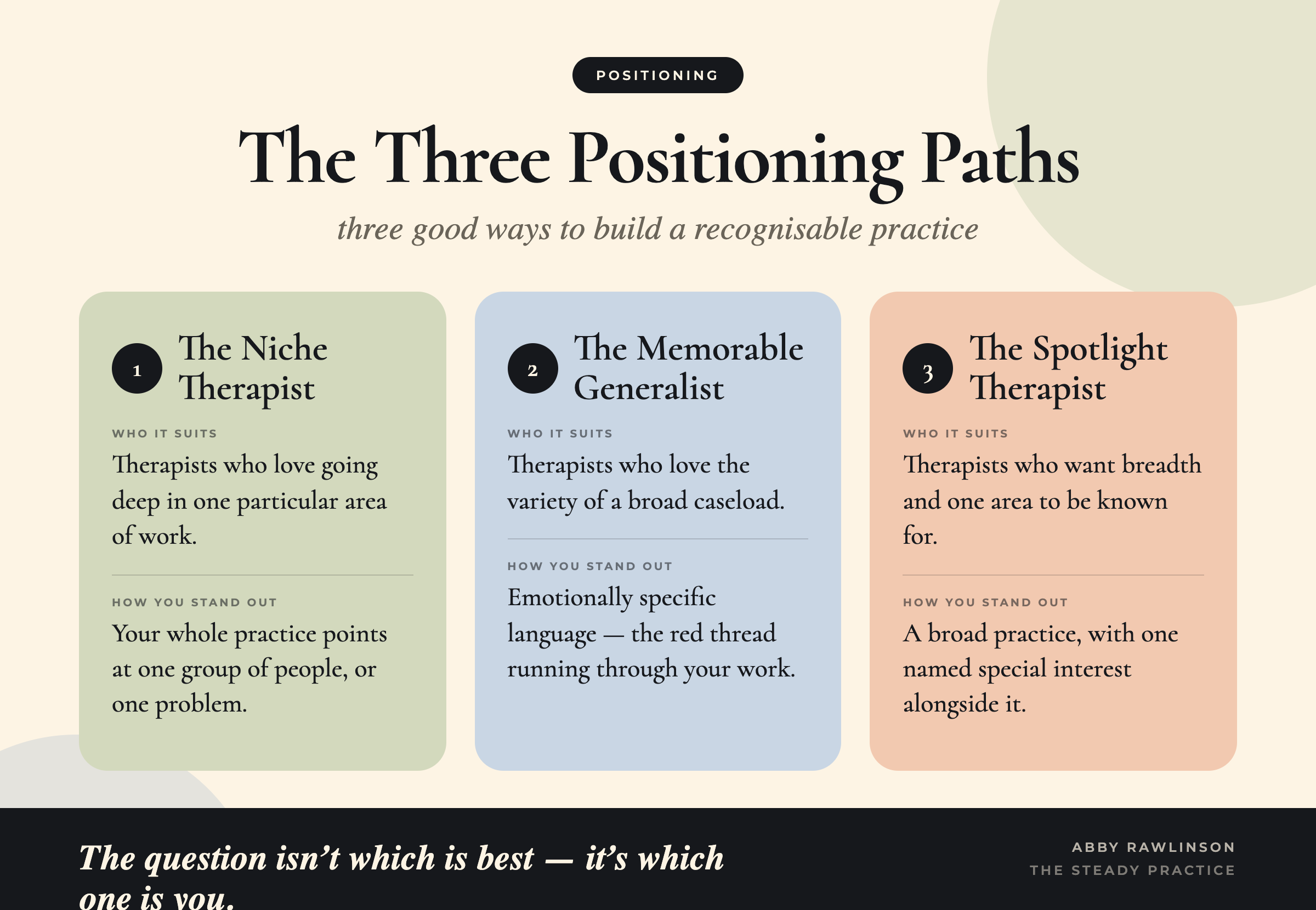
Diagram of three positioning paths for therapists: the Niche Therapist, the Memorable Generalist and the Spotlight Therapist
I'm seeing therapists become fully booked through all three of these approaches.
Because the thing that matters isn't whether you're a specialist or a generalist. It's whether the right person lands on your website and immediately feels, "this is someone who could help me."
That's positioning. And I think we've started confusing it with niching.
Why does my therapy website sound like everyone else's?
Because most therapist websites describe the space they offer instead of the client's inner world. Phrases like "safe, non-judgemental space" aren't wrong, but when everyone uses them, none of them help a client feel seen - and feeling seen is what makes someone reach out.
I think AI has accelerated this, but it certainly didn't start it. Spend ten minutes reading therapist websites and you'll start noticing the same phrases again and again:
Safe, non-judgemental space.
Helping you make sense of your experiences.
Therapy tailored to your individual needs.
None of it is wrong. It's just that if everyone says the same thing, nobody becomes memorable. The real problem is that most therapists spend too much time describing the space they provide, and not enough time helping potential clients feel seen.
That's why I teach something I call the Inner World Method. Instead of starting with your qualifications or the type of therapy you offer, you start by putting words to your client's inner world.
People don't recognise themselves in diagnoses or lists of presenting issues. They recognise themselves in thoughts, feelings and experiences. The moment someone feels seen in your words, they're far more likely to believe you can help them - and far more likely to send that first message.
Why does marketing my private practice feel so overwhelming?
Because it's usually treated as a pile of separate jobs - Instagram, SEO, directories, AI search, Google Business, newsletters - instead of one system done in sequence. When you don't know what to focus on first, you end up doing a little of everything and never feeling as though you're making real progress.
Every week there seems to be something else you're apparently supposed to be doing. It's exhausting, and it rarely moves the needle.
Therapists don't need another list of generic marketing tips. They need a roadmap built specifically for private practice - one that helps them know what to focus on, in what order, and what they can safely ignore.
Because sequence matters. There's very little point worrying about SEO if your positioning isn't clear. Or pouring hours into Instagram if your website isn't converting the enquiries you already get.
Marketing shouldn't feel like spinning plates. It should feel like building something.
What should therapists focus on first to get more enquiries?
Start with positioning, then your website message, then visibility - in that order. Get clear on who you're for and how you want to be known, put your client's inner world into words on your site, and only then invest in SEO, directories and social media. Sequence beats effort every time.
Here's the order I'd suggest if you want a steadier flow of enquiries:
Clarify your positioning. Decide how you want to be known - as a specialist, a confident generalist, or around a special interest. This shapes everything that follows.
Rewrite your core website pages around your client's inner world. Lead with how they feel and what they're carrying, not your modalities and qualifications.
Make sure your website converts before chasing traffic. If visitors aren't turning into enquiries, more visitors won't fix it.
Then choose one or two visibility channels - the ones that suit you and reach your people - and do them consistently.
Safely ignore the rest, for now. You do not have to be everywhere. You have to be clear, and findable, in the right places.
Frequently asked questions
Do I need a niche to succeed in private practice? No. A niche is one route to standing out, but confident generalists and therapists built around a special interest fill their practices too. What matters is clear positioning, not forcing yourself into a niche you don't want.
How do I make my therapy website stand out? Stop describing the space you offer and start describing your client's inner world. Put their thoughts, feelings and experiences into words so the right person recognises themselves and feels understood before they ever reach out.
Why am I not getting therapy client enquiries even though I'm doing everything? Usually because the effort is scattered rather than sequenced, and because your positioning or website message isn't landing with the right person. Doing more rarely fixes it - doing the right things, in the right order, does.
How long does it take to get more therapy clients? It varies, and anyone promising a fixed number is guessing. But when your positioning is clear and your website helps people feel seen, the enquiries you already receive tend to convert better - often before you've changed anything else.
Is social media necessary to get therapy clients? No. Social media is one channel among several. Many therapists build steady practices mainly through a clear website, directories and search visibility. It's better to do one or two channels well than a little of everything.
A steadier way to fill your practice
Over the past year, I've realised these three ideas sit underneath almost every coaching conversation I have with therapists. That's exactly why I've built The Steady Practice.
It's a 12-week roadmap for building a private practice that feels steady. One where the right people can find you, recognise themselves in your work, and feel confident taking the next step.
If you're tired of doing a bit of everything and just want a steadier flow of the right enquiries, come and join us.
The waitlist is now open, and because this is the very first cohort, it'll be the lowest price I'll ever offer.
Abby x
About Abby
Abby Rawlinson is a psychotherapist, author and private practice marketing coach who helps therapists attract more of the right clients — without living on social media or resorting to pushy tactics. She's the creator of The Steady Practice Method™: a simple, ethical framework for becoming clear, visible, chosen and sustainable. You can find her at https://www.therapywithabby.co.uk/therapistcorner